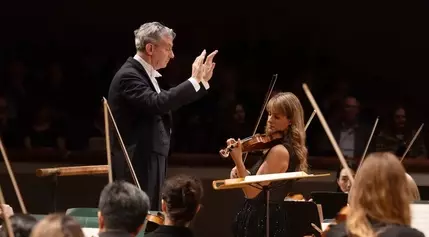
The Dallas Symphony Orchestra presented a remarkable orchestral repertory on Friday night. Just like a well-tuned car requires periodic tune-ups, orchestras too need such rejuvenation. The Beethoven Violin Concerto and Mozart Jupiter Symphony served as the perfect tonic, resetting timings and tunings and ensuring everything operated smoothly and responsively. (With no overture, the program opened with the concerto.)Music Director Fabio Luisi's Return and Its Impact
With music director Fabio Luisi back on the podium, a remarkable unity and polish were witnessed in the violin playing. It wasn't always consistent these days, but his presence brought a new level of excellence. Both the Beethoven and Mozart performances had their own personalities and an abundance of elegant details. The bassoons spun out beautiful tones and phrases repeatedly, adding to the musical tapestry. However, in both pieces, the trumpets were occasionally too obtrusive in parts that weren't particularly interesting.
The Italian-American Violinist Francesca Dego
In the Beethoven concerto, the Italian-American violinist Francesca Dego proved that pianissimos could be just as gripping as fortissimos. Her gleaming tone, played on a 1697 Francesco Ruggeri violin, was immediately striking. She explored wide dynamic ranges within individual phrases, creating a highly personalized account. Unhurried in the first movement, fairly deliberate in the second, and happily buoyant in the finale, she even stretched time for expressive effect in the first movement. With her commitment, facility, and finesse, and the Joseph Joachim cadenzas, she made a strong case for a generously molded approach. Her breathtakingly brilliant account of the Paganini Caprice No. 16 was rewarded with a rock-star ovation.
Luisi's Approach to Mozart Jupiter Symphony
With his extensive operatic experience, Luisi once again proved to be the most alert and responsive of collaborators. His approach to the Mozart Jupiter Symphony seemed a bit old-fashioned compared to his predecessor, Jaap van Zweden's newer ideas on late 18th- and early 19th-century performance practices. Luisi led the orchestra with a relatively big orchestra and muscular climaxes. However, he was onto something by approaching the Jupiter as more than just a symphony. It is actually a quite dramatic piece, and his rather operatic approach contrasted bold statements and emphases with whispered delicacies. Phrases great and small were lovingly tapered and directed, making the finale exhilarating. But his relaxed three-beats-per-measure tempo in the third movement was less convincing. Longstanding scholarship suggests that late minuets like this were meant to go at a springing one beat per measure, not three - a scherzo in everything but name.
Audience Behavior and Concert Etiquette
About a third of Friday's audience clapped after every one of the concert's seven movements, which created an awkward situation when between-movements applause wasn't acknowledged from the stage. Meyerson concerts are prefaced by announcements asking people not to record or take photos during concerts. This would be an ideal opportunity to add a reminder to hold applause until all movements have been played for the best enjoyment of multimovement compositions.DetailsRepeats at 7:30 p.m. Saturday and 3 p.m. Sunday at Meyerson Symphony Center, 2301 Flora St. to 3. 214-849-4376, dallassymphony.org.